
High consumption investigations for unexplained water bills

A bill that has doubled without anything changing is a measurement problem before it is a plumbing problem. We establish where the volume is actually going — and whether it is leaving through a pipe at all.

Burst pipe or major leak?Call 0800 520 0043

The service

The meter is right. Something is using the water.

When a water bill jumps and nothing about the site has changed, the instinct is to dispute the meter. Meters do fail, but far more often the meter is correct and something on the premises is consuming water continuously without anybody noticing — because it makes no noise, leaves no puddle and discharges straight to drain.

On commercial sites the usual suspects are rarely buried pipework at all: a urinal flush control stuck open, a float valve passing into an overflow, a cooling system topping up against a slow loss, an irrigation zone still running on an old schedule, or a closed circuit quietly making up volume all night.

We investigate the whole picture rather than jumping to excavation. Consumption is profiled, the site is isolated section by section, and where the loss does turn out to be buried we locate it acoustically. You get a written finding of what is consuming the water and what it will take to stop it.

What we do

Profile it, isolate it, then go looking.

Excavating first is how these investigations become expensive. Every stage below is designed to narrow the search before anyone breaks ground.

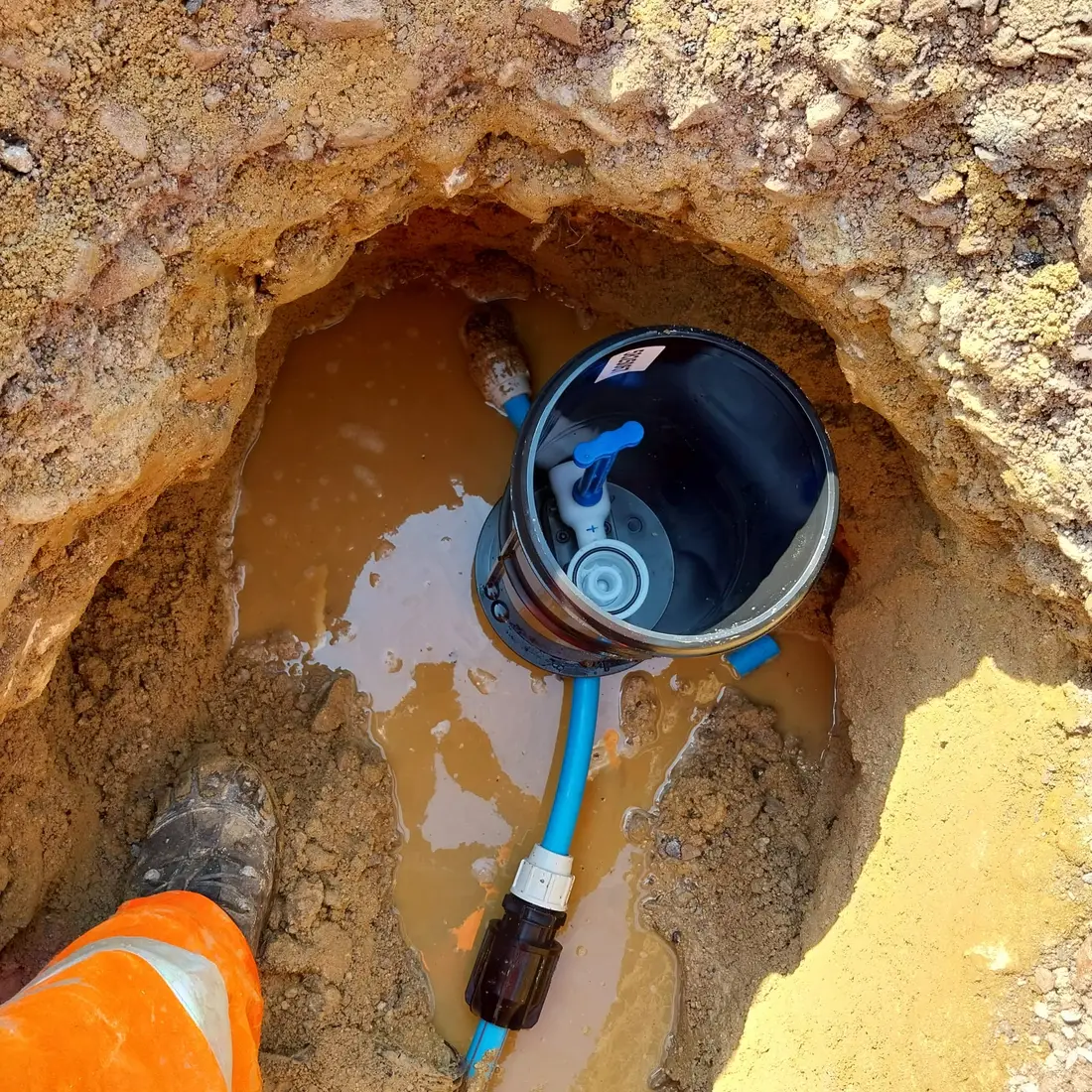
Underground water meter chamber accessed during a Cascade Water Services consumption investigation
Night flow analysis
01

Profile the consumption

We look at what the meter is actually doing, particularly overnight. A site that draws nothing when it is closed does not have a continuous loss; a site drawing steadily at three in the morning does, and the size of that overnight flow tells you roughly how big the problem is before anyone has looked at a pipe.

  • Meter readings taken and consumption profiled over time
  • Overnight and out-of-hours flow assessed against expected use
  • Billing history reviewed against occupancy and operations
  • The scale of the continuous loss quantified up front
Valve and pipe junction of the kind closed in sequence to isolate zones during an investigation
Halve the search, repeatedly
02

Isolate the site section by section

With a continuous loss confirmed, the job is to halve the search repeatedly. Valves are closed in sequence and the meter watched after each one, which narrows the loss to a wing, a floor or an external run without opening anything. Sub-metering is worth fitting where a site is large enough that isolation alone will not do it.

  • Sequential isolation to narrow the loss to a zone
  • Internal fittings, plant and external runs eliminated in turn
  • Sub-metering recommended where the site warrants it
  • A clear answer on whether the loss is buried or above ground
Repair made to a leaking supply pipe found during a consumption investigation
Findings in writing
03

Detect, repair and report

If the loss is on buried pipework we locate it acoustically and repair it. If it is a passing valve, a stuck flush control or a plant fault, we say so plainly rather than excavating to justify the visit. Either way you get a written finding you can put in front of whoever pays the bill.

  • Acoustic detection where the loss is on buried pipework
  • Repair on location once the defect is confirmed
  • Above-ground causes identified and specified for correction
  • Written finding with the volume it should recover

Why Cascade

The answer is often not a leak. We will say so.

A contractor paid to dig has an incentive to find something buried. The value here is in an investigation that is willing to conclude otherwise.

  1. 01

    We investigate before we excavate

    Profiling and isolation come first. A great many high consumption jobs are resolved without opening any ground at all, and that should be the outcome whenever it is the true one.

  2. 02

    Detection and repair in one organisation

    If the loss is buried, the team that located it repairs it. No second mobilisation, no handover to somebody who was not there when the mark was made.

  3. 03

    Thirty years across commercial and domestic

    Three decades on water systems from single dwellings to commercial sites, so the list of things we have seen consume water quietly is long and specific.

  4. 04

    Findings you can pass on

    A written finding is what a facilities manager needs to justify spend, or to take to a retailer or landlord. A verbal "we think it is over there" is not.

  5. 05

    Accredited to work on drinking water

    WaterSafe approved contractor, WIAPS registered and LRQA WIRS accredited, so any corrective work is carried out to the proper standard.

  6. 06

    24/7 where the loss is serious

    Where an investigation turns up major escaping water, response does not wait for the next working day.

Independently assessed

Full accreditation detail on the about page.

Technical detail

How a consumption problem is actually diagnosed.

This is a measurement exercise. The techniques below narrow a whole site down to a fitting without excavating to find out.

First test
Overnight flow
Consumption during hours when the site should be drawing nothing. A meter still turning overnight is the clearest evidence of a continuous loss, and its rate indicates the scale before anything is opened.
Narrowing method
Sequential isolation
Close valves in sequence and observe the meter after each. Each closure that stops the loss eliminates everything downstream of it, halving the search area without any excavation.
Large sites
Sub-metering
Where a site is too large or too complex for isolation alone, sub-meters on wings, buildings or processes turn one unexplained total into several attributable ones — and keep working after the investigation ends.
Buried losses
Acoustic detection
Where isolation points at an external run, acoustic listening and correlation locate the defect without exploratory digging, as on any leak investigation.
Ownership boundary
Public / private boundary
Pipework from the point where it crosses onto private land is the responsibility of the premises it supplies. Losses on the public side belong to the water company — and establishing which side it sits on decides who pays.
Who bills you
Your retailer
Since 2017 business customers in England have been able to choose their water retailer, so a commercial bill comes from a retailer rather than the regional wholesaler. Queries about charges go to the retailer; the pipework is still yours.
  • Urinals and float valves are the usual answer

    Automatic urinal flush controls stuck in permanent operation, and float valves passing quietly into an overflow, account for an enormous share of unexplained commercial consumption. Both discharge straight to drain, so neither leaves any visible sign at all.

  • Systems that top themselves up hide their own losses

    Cooling circuits, heating systems and anything else with automatic make-up will replace what they lose indefinitely without alarming. The loss appears only on the incoming meter, which is why the meter is where the investigation starts.

  • Irrigation is seasonal and forgotten

    Landscape irrigation running on a controller nobody has looked at in three years is a common finding, particularly where a site has changed hands or the grounds contractor has changed.

  • A meter fault is possible but uncommon

    Meters do fail, and a test can be requested through the retailer. It is worth ruling in or out — but it is rarely the explanation, and pursuing it first tends to cost weeks while the actual loss continues.

Benefits

What an investigation is worth.

  • 01

    The charge stops accruing

    A continuous loss is billed every day it runs. The saving starts the day it is found, and continues for as long as the site operates.

  • 02

    You avoid digging for nothing

    Isolation and profiling frequently locate the cause above ground, which means no excavation, no reinstatement and no disruption to the site.

  • 03

    A finding you can act on

    Written evidence of what is consuming the water, what correcting it costs and what it should recover — enough to justify the spend to whoever signs it off.

  • 04

    Damage found before it is structural

    Where the loss is buried, finding it early limits what it has been soaking into and how much drying and making good follows.

  • 05

    Better visibility afterwards

    Sub-metering installed during an investigation keeps working, so the next anomaly is visible in weeks rather than at the next annual reconciliation.

  • 06

    Clarity on who is liable

    Knowing whether the loss sits on your pipework or the water company’s decides who pays before you commit to anything.

Common questions

Before you enquire.

The questions we are asked most often about this service, answered without the sales gloss.

See all FAQs
My water bill has doubled and nothing has changed. Where do I start?

Start with the meter, not the pipework. Read it last thing at night and again first thing in the morning with the site closed and nothing drawing water. If the reading has moved, you have a continuous loss and its overnight rate tells you roughly how large. That single test decides whether this is a leak investigation or a billing query, and it costs nothing.

Could the meter simply be faulty?

It is possible and worth ruling out, and a meter test can be requested through your retailer. In practice it is rarely the explanation. Far more often the meter is accurately recording water that something on the premises is genuinely using — which is why we recommend confirming a continuous loss first rather than spending weeks pursuing the meter while the loss carries on.

What usually turns out to be the cause on commercial sites?

Overwhelmingly, things that discharge straight to drain and leave no trace: automatic urinal flush controls stuck in permanent operation, float valves passing into an overflow, cooling or heating circuits topping themselves up against a slow loss, and irrigation systems still running on a forgotten schedule. Buried pipe leaks do occur, but they are not the first place to look.

Do you have to dig to investigate?

Usually not. Profiling the meter and isolating the site section by section narrows the loss to a zone without opening any ground. Only if that points to an external buried run do we bring in acoustic detection, and even then the excavation is at a located point rather than exploratory.

Who is responsible for the loss — us or the water company?

Pipework from the public–private boundary onto the premises is the responsibility of the premises it supplies, and anything lost from it is billed to you. On the public side it belongs to the water company. Establishing which side the loss sits on is one of the first things we determine, because it decides who pays for putting it right.

Is sub-metering worth installing?

On a site large or complex enough that valve isolation alone cannot narrow the loss, yes — and it keeps earning after the investigation. Sub-meters turn one unexplained total into several attributable ones, so the next anomaly shows up in the weekly figures rather than at the annual reconciliation.

Who do I talk to about the bill itself?

Since 2017 business customers in England can choose their water retailer, so a commercial bill comes from a retailer rather than the regional wholesaler. Billing queries, meter tests and any allowance go through them. The pipework on your side of the boundary remains your responsibility regardless of who bills you.

Consumption enquiry

Send us the meter readings and the bill history.

An overnight reading with the site closed, and what the bill has done over the last year, are usually enough for us to tell you whether you have a continuous loss and roughly how large it is.

Or reach us directly

Burst main or major leak? The freephone line is answered 24 hours a day.

Request a quote

Site layouts, utility drawings, correspondence or photos of the problem. Up to 5 files, 15MB in total — PDF, JPG, PNG, HEIC, DWG or DXF.

We use these details to answer your enquiry and nothing else.