
Water consultancy for schemes built near existing mains

Not every water problem is solved with an excavator. Where a scheme sits over, beside or across existing water infrastructure, the cheapest intervention is advice — taken before the foundations are designed rather than after they are dug.

Planning a scheme?Tell us what you are building and where, and we will set out the water questions to answer first.

The service

The main was there first, and it has statutory backing.

A water main under or beside a development is not an inconvenience to be designed around informally. The undertaker has statutory rights over its apparatus, usually an easement strip that prevents building within a set distance, and a legal route by which a main can be diverted — at the cost of whoever wants it moved.

Most of the expensive surprises on site come from finding that out late. A foundation designed across an easement, a main discovered a metre from where the record showed it, or a diversion started once the programme has no slack left in it are all recoverable — but recovery is where the money goes.

Cascade has spent thirty years working on the infrastructure these schemes run into. Our consultancy work supports builders, developers and contractors planning around existing mains and supplies: reviewing what the records actually show, checking it on site, and dealing with the water company on your behalf where something has to move.

What we do

Find out what is there, then decide what has to move.

Six services on the live site, in practice three questions: what is actually underground, does the scheme conflict with it, and who has to be persuaded if it does.

Map of the London, South East and East of England area covered by Cascade Water Services water consultancy
Desk study first
01

Records review and pre-build checks

We obtain and interrogate the mains records for the site, identify what crosses or abuts it, and flag where the proposed layout conflicts with existing apparatus or its easement. Records for older networks are frequently wrong about depth, route and material, so the review says what is uncertain as well as what is known.

  • Mains drawings obtained and reviewed against the proposed layout
  • Conflicts with apparatus and easement strips identified
  • Condition and adequacy of existing supplies assessed
  • Uncertainties in the record flagged rather than glossed over
Existing gate valves in a water main chamber located during a Cascade Water Services site walk-over
Evidence, not assumption
02

Site walk-over and issue reporting

Records get you so far. A walk-over confirms what is visible on the ground — chambers, hydrants, valve covers, stop taps and evidence of routes — and turns a set of drawings into an assessment of the actual site. You get a written report setting out the risks to the construction plan and what to do about each one.

  • Site walk-over with existing apparatus located and photographed
  • Written report of risks to the proposed construction
  • Practical mitigation for each issue, not a list of problems
  • Tracing and detection arranged where the route is genuinely unclear
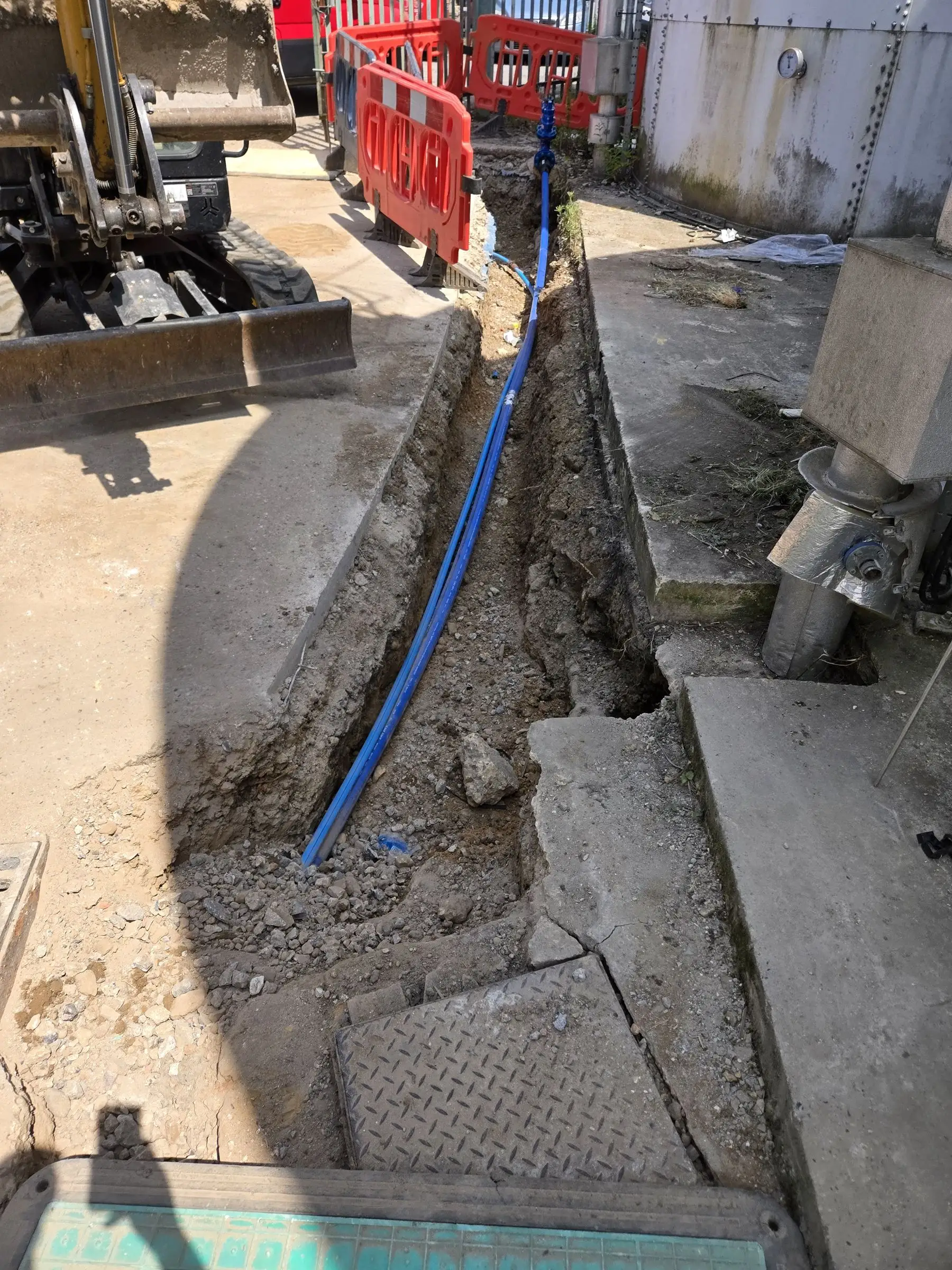
Water main being installed in a trench during a diversion carried out by Cascade Water Services
Handled on your behalf
03

Diversions, alterations and water company liaison

Where a main genuinely has to move, there is a statutory route for requiring it and a commercial process behind that. We advise on whether diversion is necessary or avoidable, prepare the case, and deal with the undertaker directly — because the correspondence goes better between two water industry parties than between a water company and a project manager running nine other trades.

  • Advice on whether a diversion is necessary or can be designed out
  • Diversion and alteration requests prepared and progressed
  • Direct liaison with the incumbent water company
  • Connection and requisition applications where new supply is needed

Why Cascade

Advice from the people who would have to build it.

The useful difference here is that we are a contractor, not a consultancy practice. Recommendations have to survive contact with the ground.

  1. 01

    Thirty years on the infrastructure itself

    We advise on mains, diversions and connections because we install, repair and divert them. Advice that would not work in a trench does not get written down.

  2. 02

    We can deliver what we recommend

    If the answer is a diversion, a new connection or a self-lay network, the same organisation can carry it out — so there is no gap between the report and someone acting on it.

  3. 03

    We speak the water company’s language

    As an LRQA WIRS accredited contractor we deal with undertakers routinely. Correspondence between two water industry parties moves faster than a developer trying to get a straight answer.

  4. 04

    Honest about what records are worth

    Mains records are a starting point, not a survey. We will tell you where the drawing is likely to be wrong and what it would cost to find out for certain.

  5. 05

    Early involvement is cheaper

    The same problem costs a fraction at pre-application that it costs once foundations are designed. We will say plainly when a scheme does not need us yet.

  6. 06

    A sister company for wider consultancy

    Cascade Water Consultancy is a separate company covering survey and consultancy work in more depth. Where a scheme needs that rather than this, we will point you there.

Independently assessed

Full accreditation detail on the about page.

Technical detail

The statutory mechanisms behind the advice.

Most of what governs building near water infrastructure sits in the Water Industry Act 1991. Knowing which section applies is usually what decides whether a problem is expensive or routine.

Diverting a main
s.185 WIA 1991
Section 185 of the Water Industry Act 1991 gives a route to require an undertaker to alter or divert a water main to enable development. The cost falls on the party requesting it, and the timescales are the undertaker’s — which is why it belongs on the programme early.
Requisitioning a main
s.41 WIA 1991
Section 41 covers requisitioning a new water main for domestic purposes, the mechanism where a site needs infrastructure that does not yet exist.
Connecting to the network
s.45 WIA 1991
Section 45 sets out the duty to connect premises for domestic purposes — the statutory basis for a new service connection.
Adoption of new networks
s.51A WIA 1991
Section 51A provides for adoption agreements covering water mains and service pipes, which is the legal footing under which a self-lay network is taken over by the undertaker.
Easement strips
Typically restricted
Undertakers normally require a clear strip either side of a main, within which building is restricted and access must be maintained. The width varies by company and by main size, so it is confirmed with the undertaker rather than assumed.
Record reliability
Indicative only
Statutory records show approximate position, not surveyed position. Depth in particular is often unrecorded or wrong. Anything critical to a design should be verified on site.
  • Diversion is not always the answer

    Diverting a main is slow and expensive. It is often cheaper to adjust a foundation design, reposition a building or accept a constrained layout — and part of the value of asking early is that those options are still open.

  • Programme risk sits with the undertaker

    Once a diversion or requisition is in the undertaker’s hands, the timescale is theirs. Applications submitted early run alongside other work; applications submitted late become the critical path on their own.

  • Protect apparatus during construction

    Plant loading over a shallow main, unrestricted access across an easement and stockpiles over apparatus all cause damage that is charged back. Site rules around existing infrastructure are worth setting out before work starts.

  • Water supply is not the only interest

    Schemes near water infrastructure frequently touch planning conditions on water demand as well. Where a local authority requires water neutrality evidence, that is a separate exercise with its own timetable.

Benefits

What early advice actually saves.

  • 01

    Conflicts found before they are built in

    An easement or a main identified at design stage is a layout adjustment. Identified after foundations are set, it is a redesign.

  • 02

    Diversions started on time

    Undertaker timescales are fixed and generous to nobody. Starting early is the only lever you have over them.

  • 03

    Fewer strikes and fewer charges

    Damage to a main during construction is charged back, on top of the delay and the supply interruption it causes.

  • 04

    A programme you can defend

    Knowing which statutory process applies, and how long it takes, turns water infrastructure from an unknown into a dated line on the plan.

  • 05

    One party for advice and delivery

    If the recommendation is a diversion, connection or network, the same organisation can carry it out rather than handing you a report and a problem.

  • 06

    Straight answers on uncertainty

    Where the record is unreliable, we say so and price finding out — rather than presenting an approximate drawing as though it were a survey.

Common questions

Before you enquire.

The questions we are asked most often about this service, answered without the sales gloss.

See all FAQs
Can I build over an existing water main?

Generally not. Water undertakers normally require a clear easement strip either side of a main, within which building is restricted and access has to be maintained for maintenance and repair. The permitted distance varies by company and by the size of the main, so it is confirmed with the undertaker rather than assumed from a rule of thumb. Where a building genuinely has to occupy that ground, the main has to be diverted.

How do I get a water main diverted?

Section 185 of the Water Industry Act 1991 provides the route to require an undertaker to alter or divert a main to enable development. The cost falls on the party requesting the diversion, and the programme is set by the undertaker rather than by you. We advise on whether diversion is genuinely necessary, prepare the case and deal with the water company through the process.

Are the mains records reliable?

They are indicative, not surveyed. Statutory records show approximate horizontal position and frequently say nothing useful about depth, and older networks are the least reliable of all. Treat them as the starting point for a site investigation rather than as a drawing you can design foundations against. Where a route matters, it should be traced and proved on site.

When should I involve you in a scheme?

Pre-application or early design, before layout and foundations are fixed. That is when the cheap options — moving a building, adjusting a foundation, redesigning around a constraint — are still available. Once those are committed, the only remaining options tend to be the expensive ones, and we can only tell you how much they will cost.

How is this different from Cascade Water Consultancy?

They are separate companies. Cascade Water Services is the installation and repair business, and this consultancy work is grounded in that — advice from the people who would have to build the answer. Cascade Water Consultancy is a sister company offering survey and consultancy work in more depth. Where your scheme needs that instead, we will say so and point you across.

Can you deal with the water company on our behalf?

Yes, and it is usually where most of the value is. We handle diversion requests, requisitions, connection applications and the correspondence around them directly with the undertaker. Being an accredited contractor on their network tends to make that exchange considerably shorter than it otherwise is.

Consultancy enquiry

Send the site plan before the foundations are fixed.

A layout, a postcode and a rough programme are enough for us to tell you whether existing water infrastructure is a constraint on the scheme — and whether it is one you can design around.

Or reach us directly

Burst main or major leak? The freephone line is answered 24 hours a day.

Request a quote

Site layouts, utility drawings, correspondence or photos of the problem. Up to 5 files, 15MB in total — PDF, JPG, PNG, HEIC, DWG or DXF.

We use these details to answer your enquiry and nothing else.