
Water meter installation and metering works

Meters fitted in boundary boxes and purpose-built chambers, shared supplies separated so each property has its own, and meters relocated out of cupboards and into the ground — tested, chlorinated and commissioned to water industry standard.

Metering enquiry?Tell us whether it is one meter, a chamber, a shared supply to separate or a site with several connections.

The service

Most metering work is not fitting the meter.

The meter itself takes minutes. What takes the time is everything around it: getting to the pipe, building a chamber that can be opened for reading and maintenance in ten years, making the connection without taking a street off supply, and proving the installation is clean before anyone drinks from it.

We install and relocate meters on domestic and commercial supplies, build boundary boxes and meter chambers, and fit manifold assemblies where one incoming supply has to serve several properties with a meter each. Where a connection has to be made on a live main, under-pressure drilling keeps the existing supply running while the new one is taken off it.

If what you actually want is a standard household meter and nothing more, the cheapest route is usually your water company: domestic customers can ask their supplier to fit one, normally free of charge. We are the people you need when that is not possible or not enough — the position is impractical, the supply is shared, the meter needs moving, the pipework in the way needs renewing, or the site is commercial and needs a chamber rather than a box.

Cascade is LRQA WIRS accredited, a WaterSafe approved contractor and registered under the WIAPS approved plumber scheme, so metering work is carried out under the same regime as the rest of the supply.

What we do

From a single boundary box to a manifold serving six flats.

The same four stages whatever the size: establish what is there, build somewhere for the meter to live, make the connection, prove it.

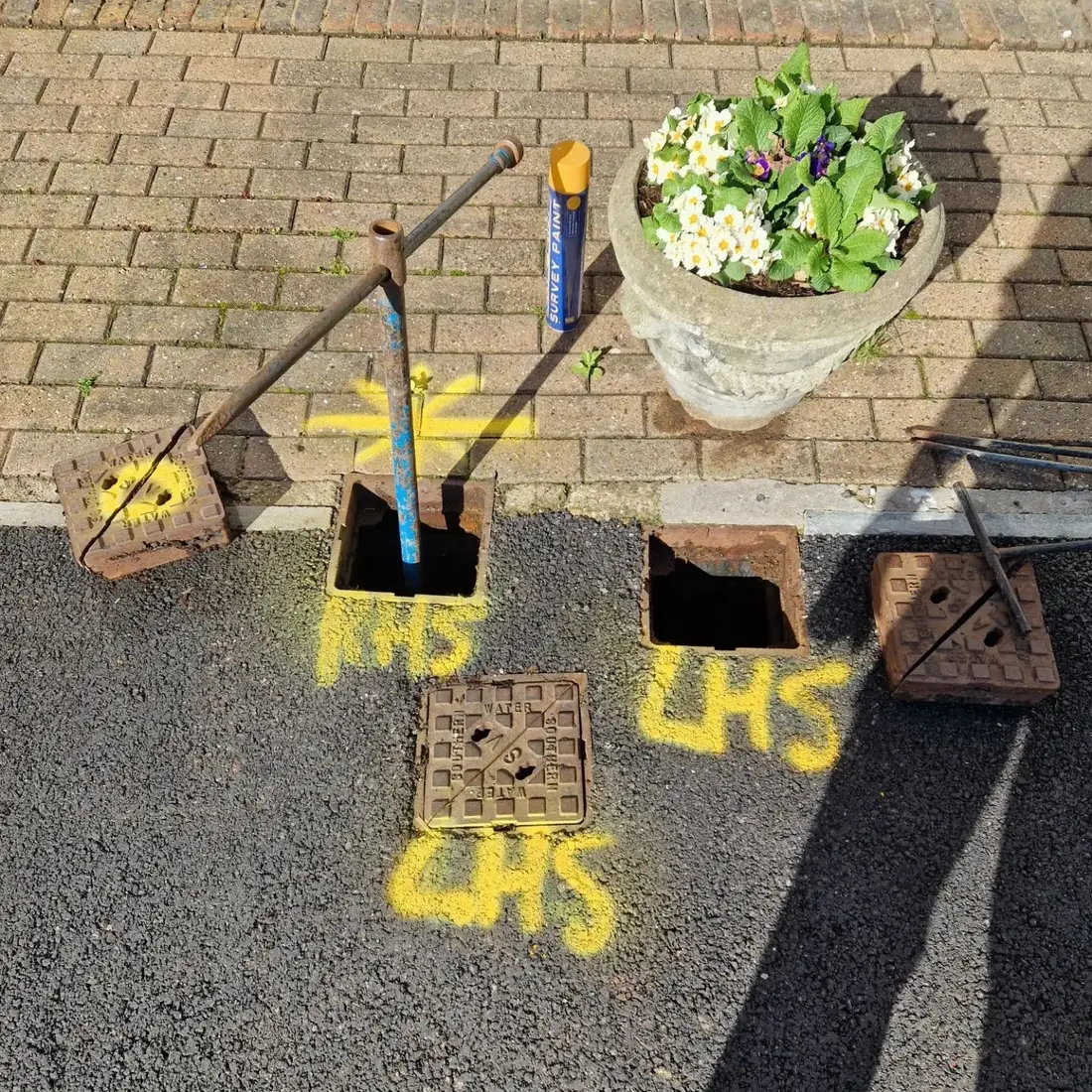
Service route marked out and chambers lifted before meter installation
Survey first
01

Establish the supply before quoting a meter

A meter has to go somewhere specific: on the property’s own supply, downstream of the boundary, accessible for reading, and deep enough not to freeze. We trace the existing run, confirm its material and size, and check whether the pipe in the way is fit to keep. Old lead or galvanised pipework beside a new meter is a job half done, and we will say so before you commit rather than after.

  • Supply traced and material confirmed before any ground is opened
  • Meter position agreed for access, depth and frost protection
  • Existing pipework assessed — renewal advised only where it is needed
  • Water company requirements for the position checked first
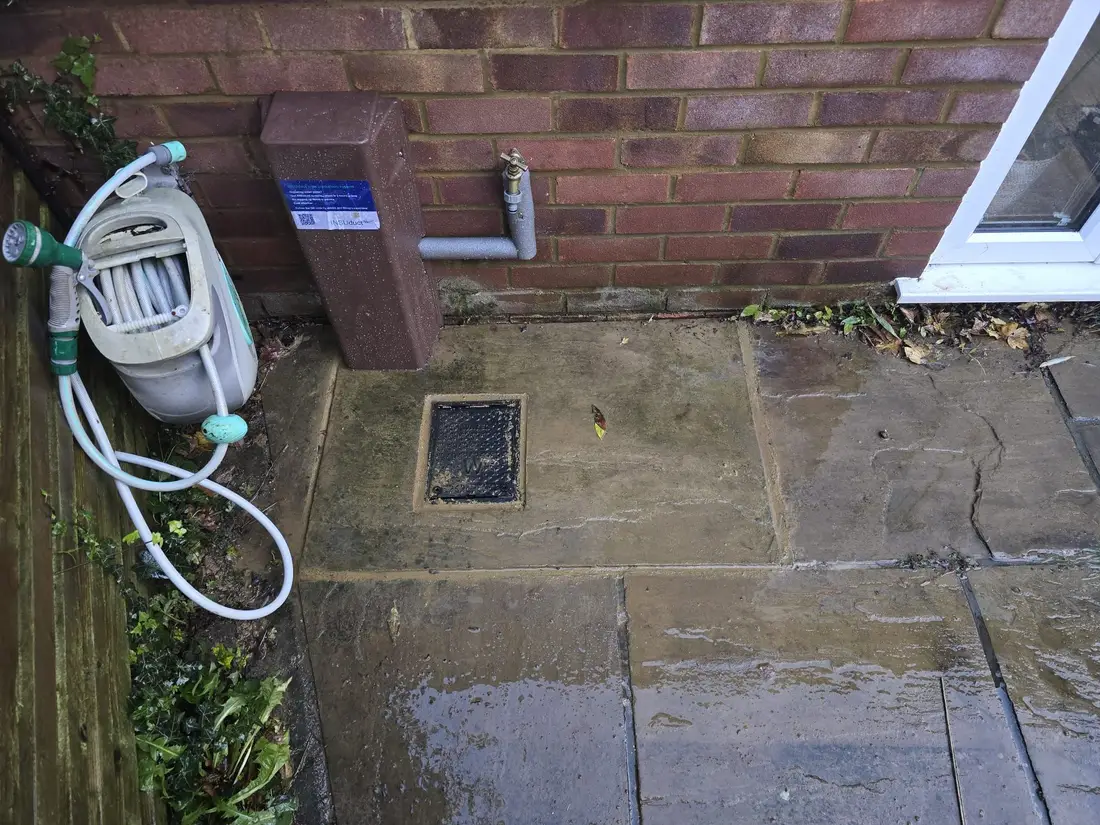
Water meter chamber set into a paved path, flush with the surface
Built for access
02

Build the box or the chamber

A domestic meter usually sits in a boundary box at the edge of the property, set to the right level in the footway or driveway so the lid closes flush and the meter can be read without lifting a slab. A commercial supply more often needs a built chamber sized for the meter, its isolation valves and whatever else has to sit with it — a check valve, a strainer or a bypass. Both are built to be opened again in ten years, not sealed in and forgotten.

  • Boundary boxes set to level in footway, driveway or garden
  • Purpose-built chambers for commercial and larger meters
  • Isolation valves, check valves and strainers fitted where required
  • Meter plating over shallow pipework where cover is restricted
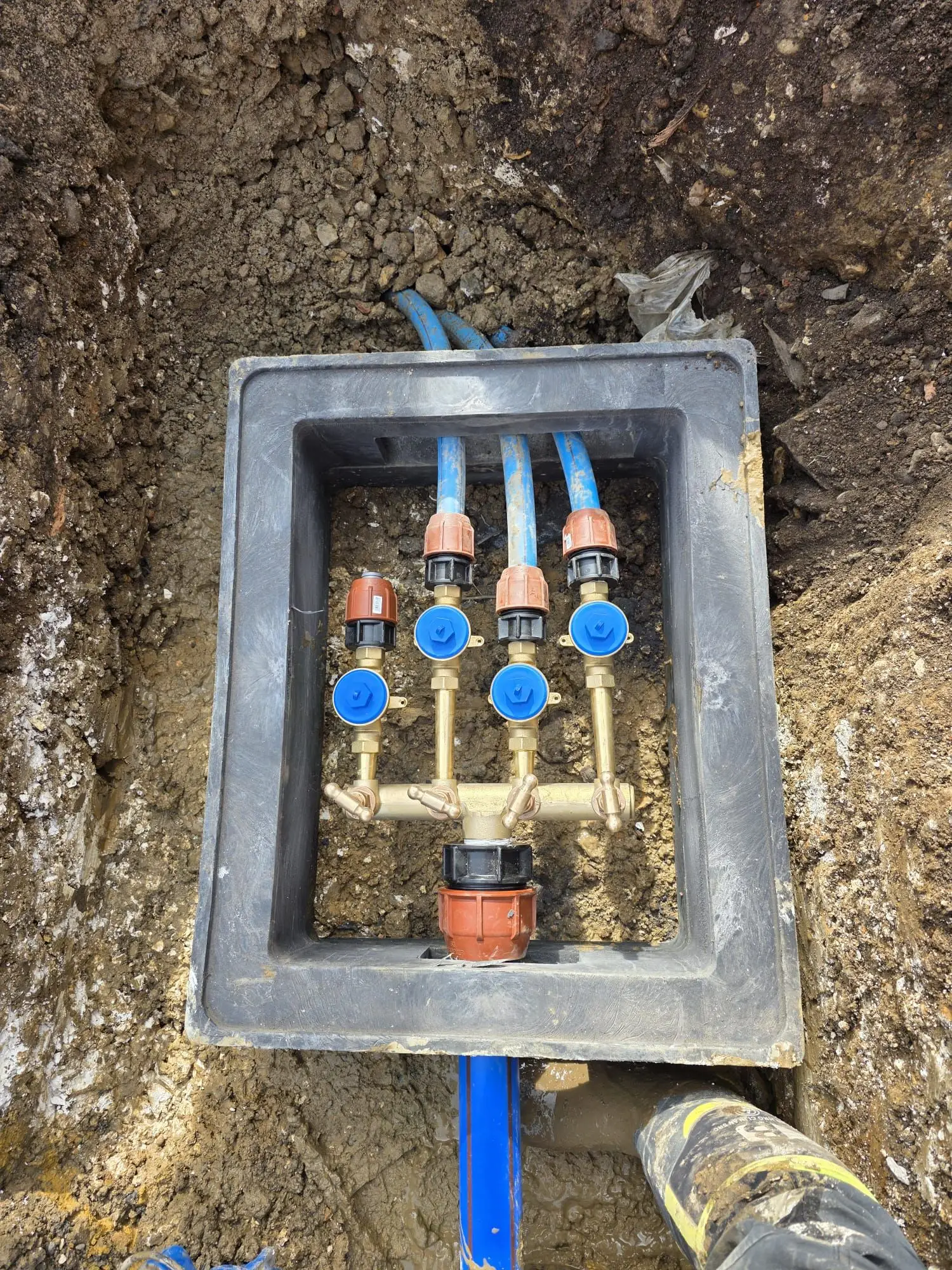
Several new metered service connections taken from one new water main
A meter per property
03

Separate shared supplies, one meter each

Converted houses and older terraces frequently run several properties off one incoming supply, sometimes with lead branches to each. Nobody can be metered or billed properly, and a leak on one branch is everybody’s problem. We install a manifold assembly — a brass header with a separate outlet and stop tap per property — so each flat or unit gets its own supply pipe and its own meter. On a recent Hitchin scheme that meant three new connections with six-port and four-port manifolds serving thirteen private supplies.

  • Manifold assemblies with a dedicated outlet and stop tap per property
  • Individual supply pipes run from the manifold to each point of entry
  • Old shared and lead branches disconnected and capped off
  • Correspondence with the water company handled throughout
Tapping tee fitted to a live water main for an under-pressure meter connection
Commissioned, not just fitted
04

Connect, test and commission

Where the meter goes onto an existing live main, under-pressure drilling taps it without taking anyone off supply. The new work is pressure tested before backfill, chlorinated and sampled where it has broken into a main, and flushed before it is handed over. The reading is recorded at handover and the surface is reinstated — footway, driveway or paving — as part of the job.

  • Under-pressure connections so existing supplies stay live
  • Pressure testing before backfill and on completion
  • Chlorination and bacteriological sampling where a main is broken into
  • Meter reading recorded and surface reinstated at handover

Metering work

Four reasons people call about a meter.

  1. 01There is no meter, or it is in the wrong place

    New meter on an existing supply

    A boundary box installed at the edge of the property, with the supply renewed back to it where the existing pipe is not worth keeping.Boundary box set to levelPipework renewed if neededReinstatement included
  2. 02It is in a cupboard, under a floor or inside a tenant’s flat

    Meter relocation

    The meter moved out to the boundary so it can be read and maintained without access to the building, which matters most on rented and converted property.Moved to the boundaryNo access needed to readOld position made good
  3. 03Several properties, one incoming pipe

    Shared supply separation

    A manifold and individual supply pipes so every property has its own metered connection, its own stop tap and its own bill.A meter per propertyOwn stop tap eachOld branches capped offRead more
  4. 04A site, a landlord or a tenancy to apportion

    Commercial and sub-metering

    Chambers, larger meters and sub-meters on branches within a site, so consumption can be split between units or tracked where it is being lost.Purpose-built chambersSub-metering by branchNight flow profiledRead more

Why Cascade

Metering is supply pipe work with a meter on it.

The meter is the easy part. The accreditations below exist because of everything the meter is connected to.

  1. 01

    LRQA WIRS accredited

    Water Industry Registration Scheme, independently assessed, covering construction of mains and services and routine and under-pressure mains connections within our accredited scope.

  2. 02

    WaterSafe and WIAPS

    Approved contractor status for work on drinking water, and registration under the scheme covering work carried out under the Water Supply (Water Fittings) Regulations.

  3. 03

    Live connections without a shutdown

    Under-pressure drilling is routine work here, so a new metered connection does not mean taking a street, a building or a tenant off supply while it is made.

  4. 04

    We renew what is behind the meter

    Fitting a meter onto failing lead or galvanised pipework measures the problem rather than solving it. We can renew the supply and meter it in the same visit.

  5. 05

    Chambers built to be opened again

    Set to level, lids that close flush, isolation where it is reachable. A meter chamber that cannot be read or maintained has to be rebuilt, usually at someone else’s expense.

  6. 06

    Reinstatement included

    Footway, driveway, block paving and landscaping put back as part of the job, to the highway authority’s specification where the work is in the public footway.

Independently assessed

Full accreditation detail on the about page.

Technical detail

What a compliant meter installation has to satisfy.

Who owns the meter
Water company
On a standard domestic supply the meter belongs to the water company and remains their asset, even where a contractor installs it. The pipework either side of it, on the private side of the boundary, belongs to the property.
Typical domestic meter
15–25mm
Sized to the supply rather than the property. Over-sizing a meter loses accuracy at low flows, which is exactly where a continuous leak shows up.
Depth of cover
750–1350mm
A supply pipe outside a building must sit no less than 750mm and no more than 1350mm below ground. A boundary box is built so the meter sits within that, with the lid flush to the surface above.
Live connection method
Under-pressure drilling
Tapping a live main under pressure so the existing supply is never interrupted. Used where a shutdown would affect other properties or a site that cannot lose water.
Commissioning
Test, chlorinate, sample
Pressure testing before backfill, then chlorination, flushing and bacteriological sampling wherever the work has broken into a main, before the supply is handed back.
Materials
Approved fittings
Meters, boxes, manifolds and fittings approved for use with potable water and compliant with the relevant adopting-company and drinking-water requirements. Barrier pipe where ground conditions require it.
  • Ask your water company first for a standard household meter

    If all you want is a meter on an ordinary domestic supply in an ordinary position, your water company will normally fit one free of charge on request, and that is the sensible first call. Our metering work starts where theirs stops: positions their contractor will not serve, supplies shared between properties, meters that have to be moved, pipework that needs renewing first, and commercial installations.

  • A meter on a bad pipe just measures the loss

    Metering an old lead or galvanised supply is common and rarely a good idea on its own. The meter will faithfully record water escaping through a pipe that was going to need replacing anyway, and the first bill is often what prompts the call. Where the run is at the end of its life we would rather renew it and meter the new one.

  • Shared supplies cannot be fairly metered as they are

    Where one pipe feeds several properties there is nothing to meter per property, and a leak on any branch is billed to whoever holds the account. Separating the supply with a manifold gives each property its own connection, its own stop tap and its own meter — and usually resolves a long-running billing argument at the same time.

  • Smart meters are specified by the water company

    Where a water company is running a smart or automated reading programme, the meter type and the reading infrastructure are theirs to specify. We install to the specification provided rather than recommending a make or holding stock of our own.

Benefits

What a proper metering job gets you.

  • 01

    Billing you can defend

    A meter on your own supply, in a position that can be read, measuring your water and nobody else’s.

  • 02

    Leaks become visible

    An accurate meter is the cheapest leak detection there is. A reading taken last thing and first thing with nothing running tells you whether you have a continuous loss.

  • 03

    Access without entering the building

    A meter at the boundary can be read and isolated without arranging access through a tenant’s flat or a locked cupboard.

  • 04

    One contractor for pipe and meter

    Where the supply needs renewing as well, both happen in one visit with one excavation and one reinstatement.

  • 05

    No shutdown on live sites

    Under-pressure connections mean an occupied building or a working site keeps its water while the new metered supply is made.

  • 06

    Evidence at handover

    Test records, sampling results where applicable and the opening reading, which is what you want if the first bill looks wrong.

Common questions

Before you enquire.

The questions we are asked most often about this service, answered without the sales gloss.

See all FAQs
Can I get a water meter fitted for free?

On a standard domestic supply, usually yes — household customers can ask their water company for a meter and it is normally installed free of charge. It is worth asking them first. The reasons people come to us instead are that the company’s contractor cannot serve the position, the supply is shared with other properties so there is nothing to meter individually, the meter needs moving, the pipework has to be renewed before a meter is worth fitting, or the supply is commercial and needs a chamber rather than a boundary box. That work is chargeable and we quote for it.

Where should a water meter be installed?

Ideally in a boundary box at the edge of the property, on the private side of the boundary, where it can be read and isolated without entering the building. Inside the building, next to the internal stopcock, is the usual alternative where an external position is impractical. The meter must sit within the same depth range as the supply pipe, 750mm to 1350mm below ground outside, with a lid that closes flush to the surface.

Who owns the water meter, me or the water company?

On a standard domestic supply the meter is the water company’s asset and stays theirs, even if a private contractor installs it. The supply pipe either side of it, from the boundary into the building, belongs to the property. That split is also why the position matters: the company needs to be able to read and change their meter without needing access to your house.

Can you install a meter without turning the water off?

Where the connection has to be made on a live main, yes. Under-pressure drilling taps the main while it is still in service, so the new metered supply is taken off without interrupting anyone else. It is the normal method on commercial sites, occupied buildings and streets where a planned shutdown would affect other properties.

We have several flats on one supply. Can each have its own meter?

Yes, and it is common work. One incoming pipe feeding several properties cannot be fairly metered as it stands. We install a manifold — a header with a separate outlet and stop tap for each property — then run individual supply pipes from it to each point of entry, so every flat has its own connection, its own isolation and its own meter. Old shared or lead branches are disconnected and capped off. It needs agreement between the owners first, and we will explain how the work usually divides.

Do you install commercial and sub-meters?

Yes. Commercial supplies usually need a purpose-built chamber rather than a boundary box, sized for the meter and its isolation and any check valve or strainer that has to sit with it. Sub-meters on branches within a site are also routine, whether to apportion consumption between tenants or to narrow down where water is going during a consumption investigation.

Can you move an existing meter?

Usually. The common case is moving a meter from inside a building — a cupboard, under a floor, or inside one tenant’s flat — out to a boundary box, which removes the access problem permanently. It means a new connection point and new pipework between the two positions, so it is worth doing at the same time as any supply pipe renewal.

Will a meter show up a leak?

It will show a continuous one. Turn everything off, take a reading, leave it an hour or take it again first thing, and if the meter has moved something is running. That is often how a supply pipe leak is first found, and it is why a meter fitted to an ageing lead or galvanised run so frequently produces a surprising first bill.

Do you fit smart meters?

Where a water company specifies one as part of their programme, we install to the specification they provide. We do not recommend a particular make or hold stock of our own, and the reading infrastructure behind a smart meter belongs to the water company rather than to us.

Which areas do you cover for metering work?

London, Hertfordshire, Bedfordshire, Essex, Cambridgeshire and Buckinghamshire. Send a postcode and a description of the supply and you will get a straight answer on whether we cover it.

Metering enquiry

Tell us what the supply looks like.

Whether it is one meter in a front garden, a chamber on a commercial site, or one pipe feeding six flats that needs separating — a description, a postcode and a photo of the existing stopcock are enough for us to tell you what is involved.

Or reach us directly

Burst main or major leak? The freephone line is answered 24 hours a day.

Request a quote

Site layouts, utility drawings, correspondence or photos of the problem. Up to 5 files, 15MB in total — PDF, JPG, PNG, HEIC, DWG or DXF.

We use these details to answer your enquiry and nothing else.